



Stainless steel mixing tank with agitator materials, impellers and daily maintenance
Suitable mixing materials are liquid, paint, coating, ink, polymer, grease, glue, epoxy resin, chemicals, cosmetics, leather paste, dyes, rubber, medical pharmaceutical, food and beverage, etc.
Mixer impellers classifications
Paddle agitator
Paddle agitator is a relatively simple structure of the agitator, its mixing parts are two blades. Paddle agitator can be divided into flat paddle agitator and oblique paddle agitator according to the shape characteristics of the impeller. Flat paddle agitator produces radial force, oblique paddle agitator produces axial force. Paddle agitators are suitable for mixing liquids, suspensions and solubles of low viscosity.
Propeller agitator
Propeller agitator is a type of agitator with two or three propulsive propellers as mixing components. The propeller agitator has a high rotation speed when mixing, which can force the material to move along the axial direction, so that the material is fully circulated and mixed. Propeller agitator is suitable for mixing liquids, suspensions, emulsions and other materials with low viscosity.
Turbine agitator
Turbine agitators are usually designed with two to four blades, which can be flat or curved and are mounted on a horizontal disc. The highly turbulent radial flow of the material is formed when the turbine agitator rotates. Turbine agitator is suitable for mixing between gas or liquid materials with low viscosity and poor miscibility.
Anchor agitator
The blade shape is very similar to the anchor of the ship. The blade size of the anchor agitator is similar to the size of the mixing tank, and only a small gap is left, so that the blade of the anchor agitator can remove the reactants on the inner wall of the mixing tank when rotating, and maintain the mixing effect of the agitator. Anchor agitators can be used for mixing materials with higher viscosity.
Ribbon-spiral type agitator
The blade shape is ribbon spiral, usually two or three spiral ribbons , which are installed on the shaft in the center of the mixer. Ribbon agitators are usually operated in a laminar flow state and are suitable for mixing high viscous liquids and fluids.
Operation and maintenance
1. Regular cleaning: Clean the internal and external surfaces of the mixing tank regularly to prevent dust, dirt and corrosion. Use appropriate cleaners and tools to ensure that the mixing tank is kept clean and hygienic.
2. Check the seals: Regularly check the seals of the stainless steel mixing tank, such as sealing rings, gaskets, etc., to ensure that they are intact. If the seal is found to be worn, aged or damaged, it should be replaced in time to prevent leakage.
3. Check the stirrer: Check the operation of the stirrer regularly to ensure that the stirrer is not loose or damaged. If the mixer is found to have abnormal sound, vibration or abnormal movement, it should be stopped in time for maintenance.
4. Check the electrical system: regularly check the electrical system of the mixing tank, including the air motor, valve, hose, etc. Ensure that the electrical system is running properly and there are no problems such as loosening and corrosion.
5. Transmission parts lubrication: regularly lubricate the transmission parts, such as the reducer, bearings, etc. Use appropriate lubricating oil or grease to ensure smooth operation of transmission components.
6. Check valves and pipes: Check the valves and pipes at the inlet and outlet regularly to ensure that the valves operate flexibly and without leakage. Clean pipes to avoid clogging and accumulation.
7. Calibration and adjustment: Regularly calibrate liquid level sensors, temperature sensors and other necessary equipment to ensure their accuracy. If necessary, adjust the mixer to ensure the best mixing results.
8. Anti-corrosion maintenance: According to different processes and materials, the stainless steel mixing tank need to do anti-corrosion maintenance. Take appropriate measures to prevent corrosion and oxidation.
Selection
|
Stainless steel tank with agitator Selection guidelines |
|
|
Industry category |
Chemical ____ Painting ____ Food and drug ____ others ____ |
|
Stirring purpose |
Homogenization____ Mixing____ Dispersion____ Suspension____ |
|
Container |
Square bucket: length____MM width____MM height____MM |
|
Tank material requirements |
SS201____ SS304____ SS316____ |
|
Tank wall thickness requirement |
3MM____ 4MM____ 5MM____ others____ |
|
Tank inside and outside surface treatment requirements |
Brushed Stainless Steel____ |
|
Tank lid requirement |
Flange type____ |
|
Tank bottom head type requirement |
Flat bottom____ Elliptic bottom____ |
|
Distance from tank bottom to the ground |
____MM |
|
Tank supporting legs requirement |
Three legs____ |
|
Mixing material |
Liquid + liquid mixture____ |
|
Tank inside pressure |
Normal pressure____bar |
|
Mixing speed requirement |
____RPM |
|
Air pressure at end users' operating site |
____BAR ____PSI |
|
If need heated? |
Yes(electric heating____ water or oil cycle heating____) |
|
If need heat preservation? |
Yes____ No____ |
|
If need a temperature control box? |
Yes____ No____ |
Finished products pics for DSV stainless steel mixing tank with agitator
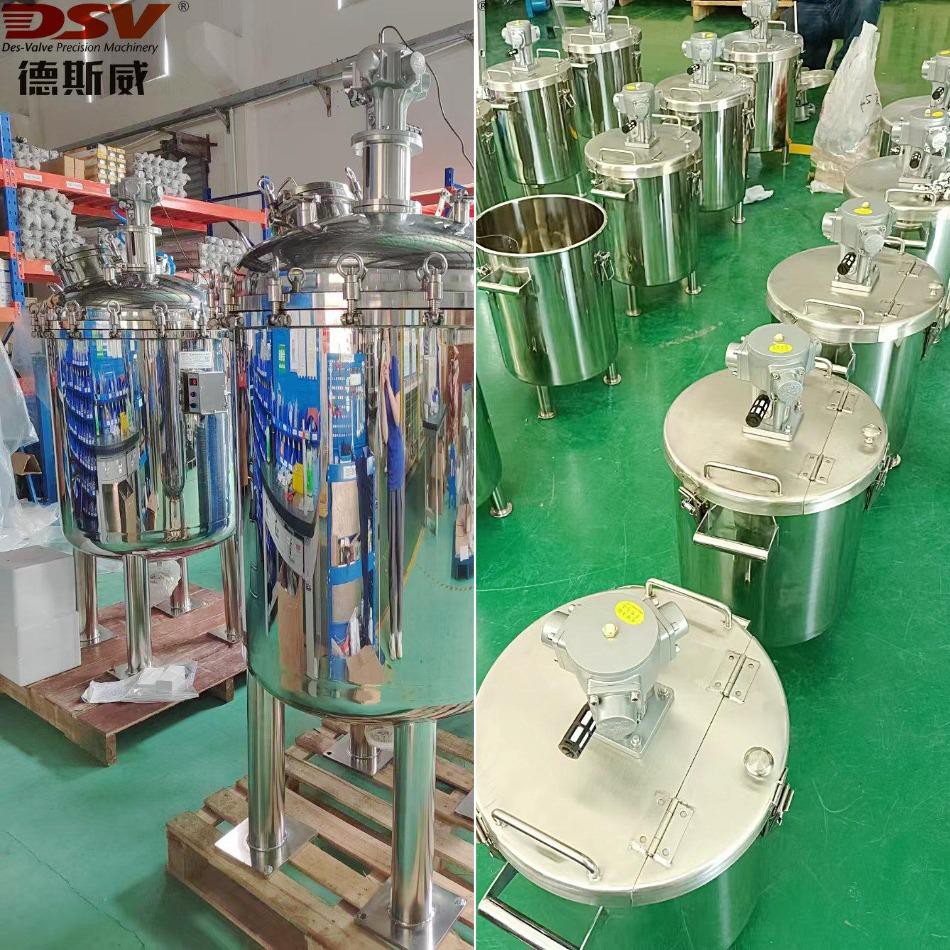


Hot Tags: stainless steel mixing tank with agitator, China stainless steel mixing tank with agitator manufacturers, suppliers, factory, air mixing tank with cooling jacket, air mixing tank for electronic chemicals, air mixing tank hygienic design, air agitator vessel, air mixing tank sanitary fittings, air mixing tank valve mounted design